
Etymology
What if spelling are spells?

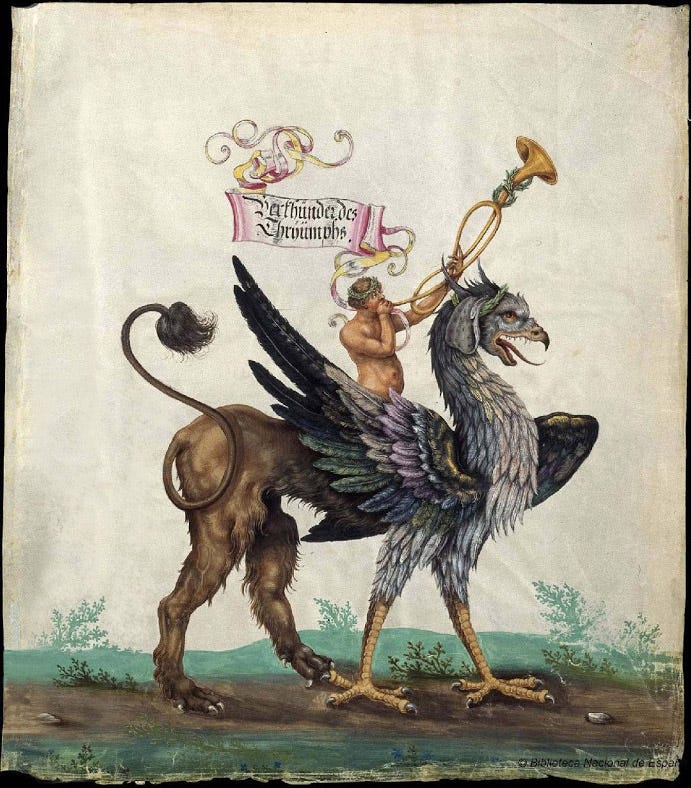
Derived from the Greek word étymon, meaning “true sense” or “true meaning,” etymology is the study of the origin and structural development of words. If we trace the forms and meanings of words far enough back, we can then decipher a code embedded within language itself. And perhaps, begin to understand why words are spells.
Etymology investigates the evolution of language by analyzing word roots, tracing their transformations, tracking borrowings across cultures, and identifying ancient Anglo-Saxon, Latin, and Greek foundations. It reveals that language is alive, layered, and encoded.
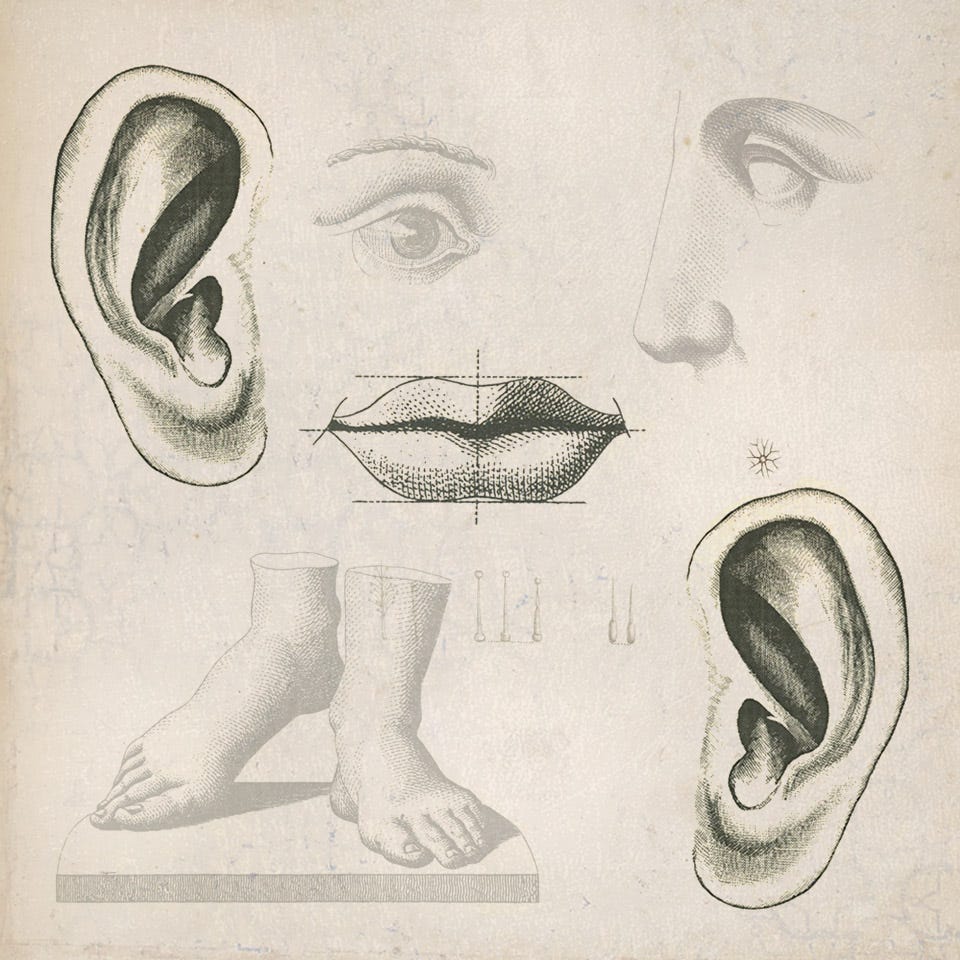
Words, particularly when spoken, are something we often take for granted. We live in a society that demands to be heard rather than to listen. I was once told to notice that we have two ears and one mouth, pointing to perhaps listening is twice as important as speaking.
The origin of words is fascinating, and requires some diligence, since meanings have changed over time. Tracking the oldest origins is where, quite literally, the magick is!
Spelling
Pay attention to what those who rewrote the dictionaries want you to believe in the first few words →
“The oldest senses are obsolete.”
From circa 1200, spell meant “an utterance, something said, a statement, remark.” By the 1570s, it carried the meaning: “a set of words with supposed magical or occult powers; incantation; charm.”
The Oxford Dictionary of English Folklore notes:
“The term ‘spell’ is generally used for magical procedures which cause harm, or force people to do something against their will — unlike charms for healing or protection.”
Yet this harmful connotation does not appear in early Middle English.
Gower (1390) refers to “spelling of charmes” as the casting or reciting of spells. Chaucer uses night-spell to mean “a charm for protection from evil spirits in the night.”
The Encyclopaedia Britannica (1941) states:
“In general terms, the belief underlying the use of spells is that the wish they embody will be fulfilled, so long as the formula has been correctly pronounced.”
Spell and prayer, magic and religion, variations of intention. In Old English, spel also meant “doctrine; sermon; religious instruction; the gospel; a book of the Bible.”
Consider gospel —> “good spell.”
The 11th-century glossaries even give spel as a translation for the Latin fabula: a story.
A spell, a story and a doctrine, all spoken.
Language has the ability to shape beliefs, which then shape perception and then perception shaping reality.
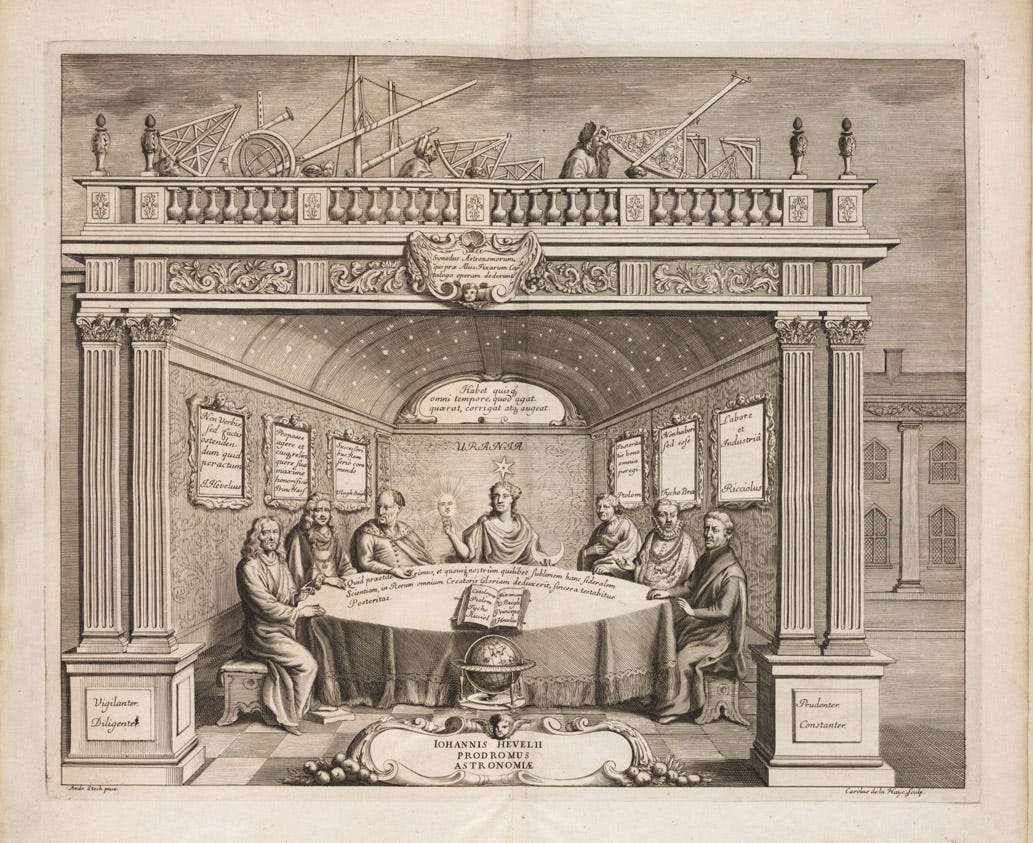
Inspire (n.)
The word inspire (mid-13th century) originally meant “life, the animating principle in humans and animals.” It comes from the Latin spiritus, breath, respiration, wind, and also “breath of a god.”
To be inspired was once to be filled with divine breath.
By the 1400s, inspired meant “communicated by supernatural powers.” By the 1660s, it described someone infused with seemingly otherworldly influence.
As Thomas Browne wrote in Religio Medici:
“In brief, conceive light invisible, and that is a spirit.”
To inspire is to breathe into. Words are breathed, caring sounds of intention. Consider the resonance found in old cathedrals.
Cursive (adj.)
Cursive (1784) refers to writing in which letters are joined and formed rapidly without lifting the pen. It comes from the French cursif, from Medieval Latin cursivus, meaning “running,” from Latin currere, to run.
In cursive writing, letters flow together. Running, current, course, and perhaps, curse.
According to Webster, “curse” may stem from the Latin cursus, the course of daily liturgical prayers.
Language moves like a current, carrying force.
Grammar (n.)
By the late 14th century, grammar meant “Latin grammar; rules of Latin.” It derives from Old French gramaire, which also carried a secondary meaning: “magic, incantation, spells.”
Learning itself was once associated with the occult. During the so-called Dark Ages, literacy was rare. Knowledge, especially of Latin, belonged to the learned class, which included astrologers, alchemists and magicians.
Thus grammar evolved a secondary meaning: occult knowledge. In Scottish usage, this eventually became glamour. To understand grammar was to wield power.
A grammar school originally taught Latin by memorizing grammatical forms. In the United States, the term later came to mean a school between primary and secondary levels, but the original association with sacred language is telling.
So What If Spelling Is Spells?
If words once meant incantations, grammar occult knowledge and inspiration divine breath, then what exactly are we doing when we speak?
If speaking once carried magical force, what does it mean that we still “spell” our words? Perhaps language is not merely descriptive but creative, every sentence a subtle ritual.
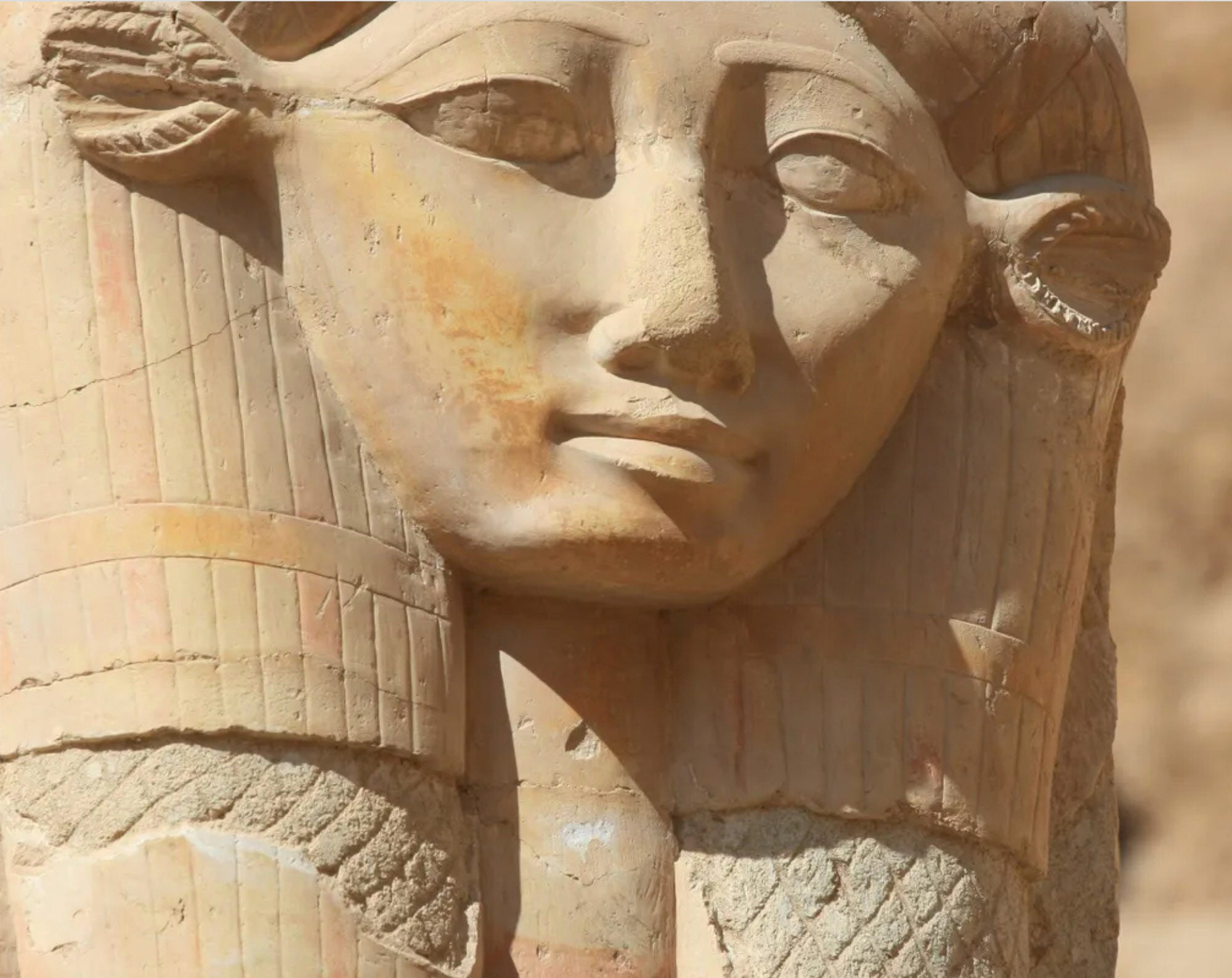
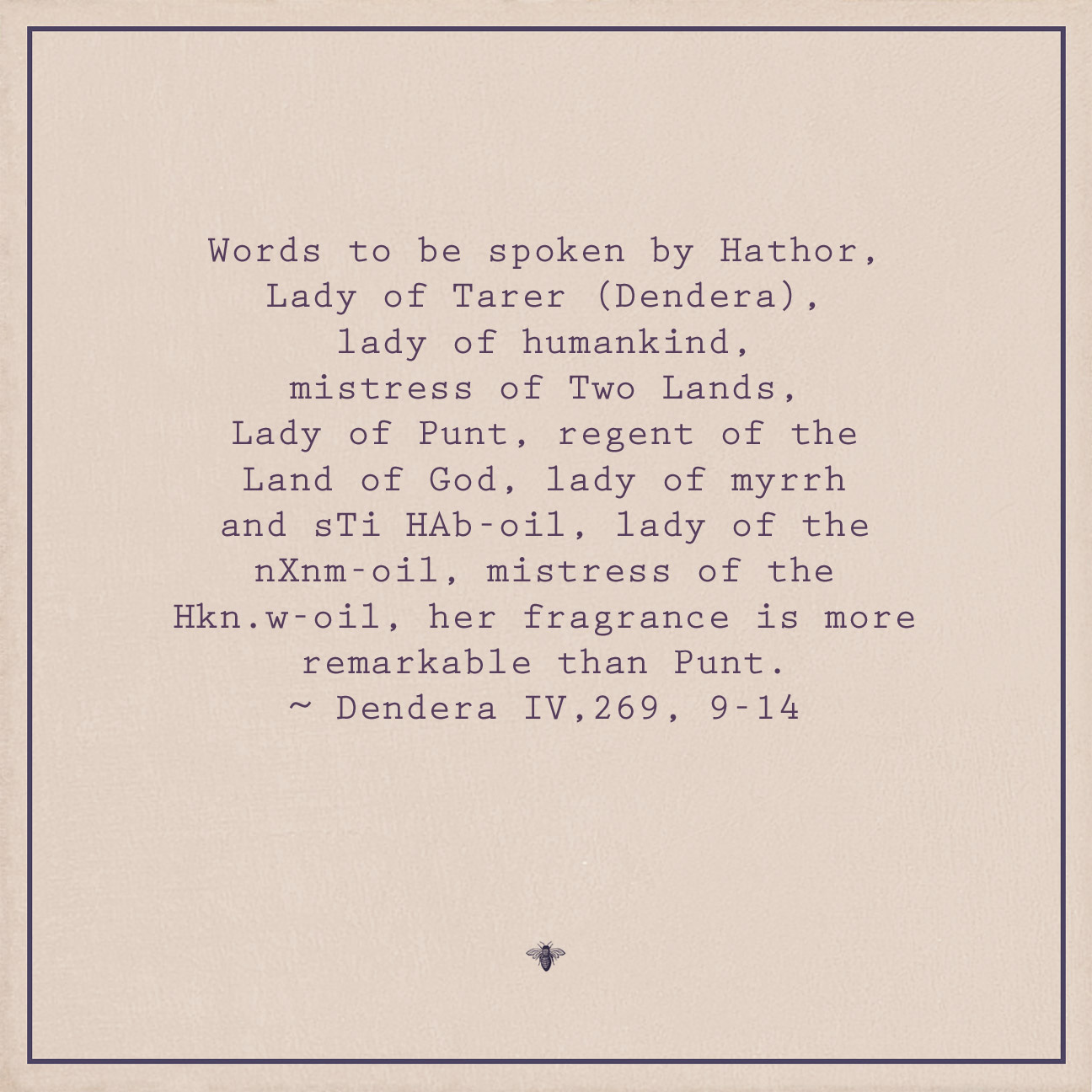
In the ancient Egyptian funerary texts, what we now call the Book of the Dead, there are spells addressed to the Goddess Hathor. One such spell is spoken so that the deceased may “be in the presence of Hathor.”
The ancient Egyptian word often translated as “magic”, ḥeka, was a cosmic principle. To speak the correct words, in the correct sequence, with the correct breath, was to participate in creation itself.
And Hathor, goddess of beauty, music, intoxication, and perfume, presided over this sensory theology.
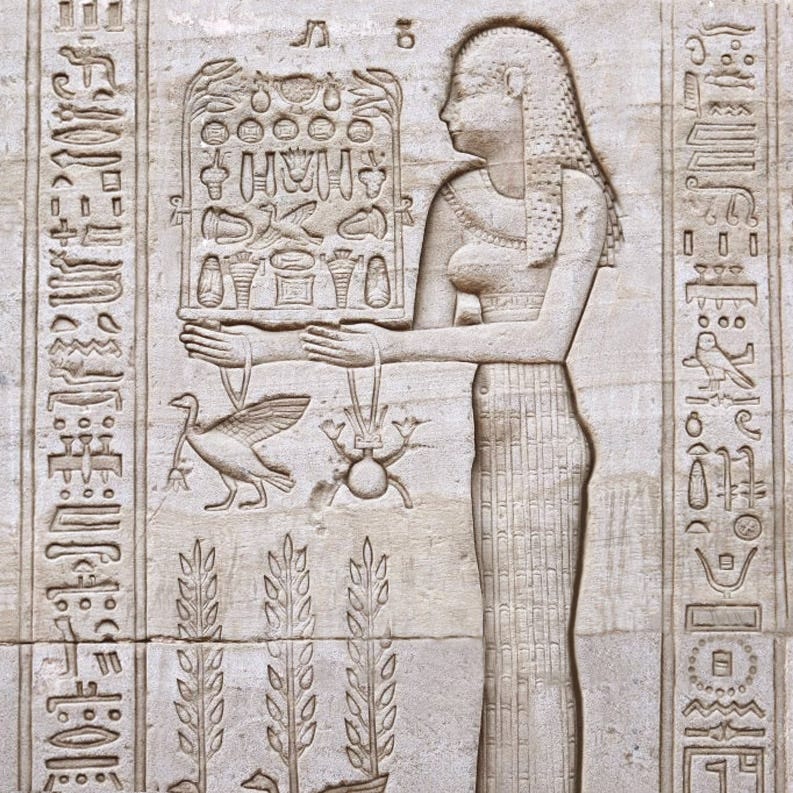
Her rituals involved:
Incense rising like prayer
Oil poured onto skin
Sistrums shaking rhythm into air
Names spoken into vibration
Breath carrying sound
Smoke carrying scent
Scent is invisible, altering mood, while summoning memory and changing a perception, without ever being seen. Words operate in a similar manner, as unseen forces that enter through breath and alter inner states.
We can observe how both perfume and language are structured invisibility. A composed formula of aroma molecules can enchant a room, as a composition of syllables can enchant a mind.
In Egyptian ritual, the god was invited through scent and through speech, the two as intwined arts. When we spell, we are arranging symbols with intention.
When we speak, we are breathing life into those symbols.
And when intention, breath, and structure align, this becomes a ritual. Consider each word uttered into the air is a kind of incense, an invisible offering shaping the unseen.
Thanks to Etymology online for assistance with translations.
Thank you for the lovely words and appreciation Bill.
"To inspire is to breathe into." This is a golden statement. After all, we are nothing but the breath of God. I really love studying etymology, because words are spells. The proof of the matter is that English is a violent language. With modern phrases such as: "You're killing it!" "Take a stab at it!" The intention is to be positive while saying these things, but the frequency is of low nature. Thank you for your wonderful insights as always, Roxana! :)