
The Goddess Hathor
Part One: Setting the Stage

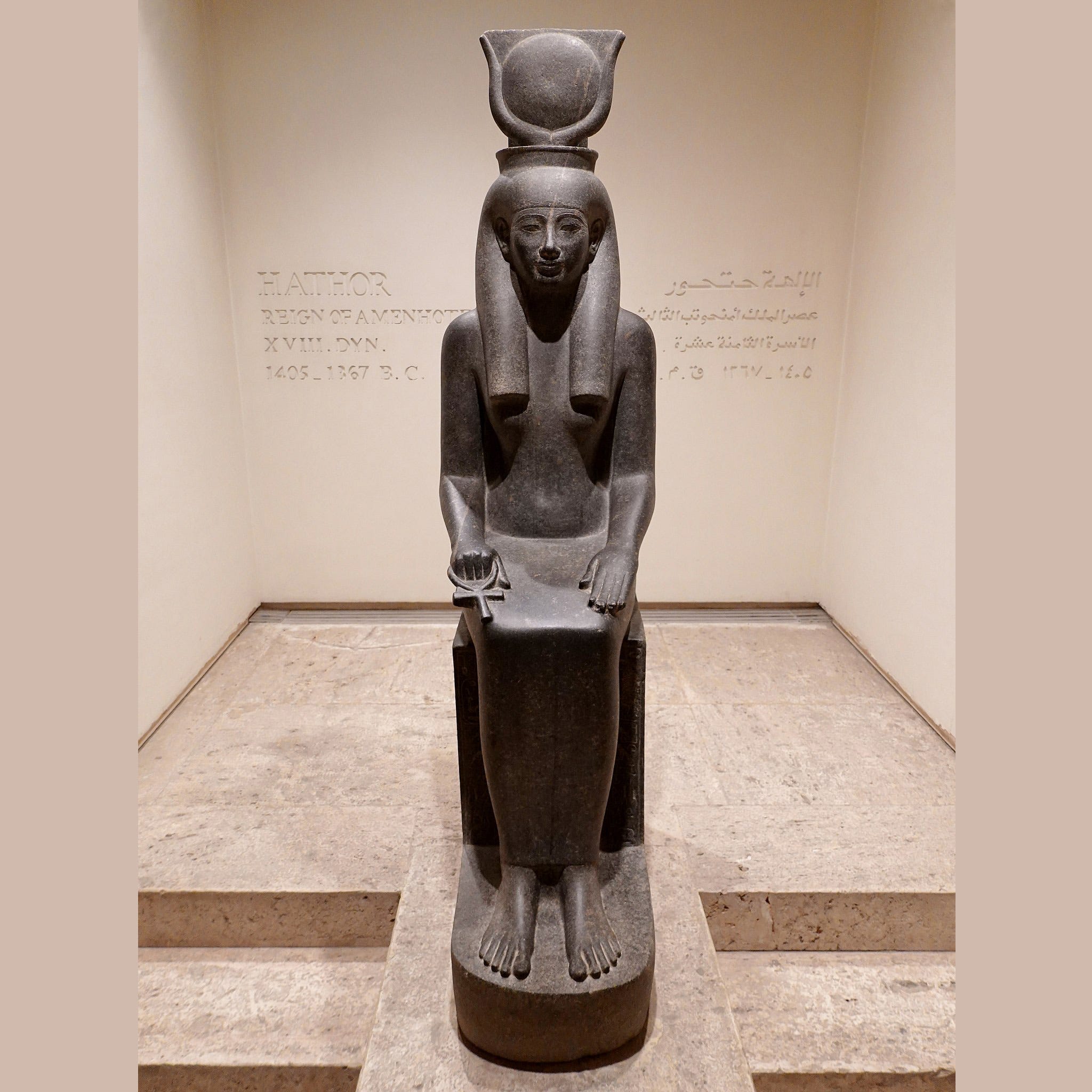
Wafting love to all the Mamas today, and every day.
While contemplating what to write, the image of the Hathor appeared, she is an archetype of a mother goddess from ancient Egypt, depicted on temple walls and surviving manuscripts. She appears as benevolent, one who nurtures the land, her people and the dead. Like Venus and Aphrodite, she represents love, beauty and harmony, unlike the Roman and Greek goddesses, her symbolism goes much deeper.
At the temple of Dendera we see her on the tops of columns and walls as a celestial cow deity, sometimes with ears, wearing a solar disc and/or with a headdress of horns.
In studying her through various texts and workshops with teachers, I noticed that having context in a linear format helps me understand the material more clearly.
This becomes very relevant, since ancient Egypt extends over a vast timeline, especially if the theories of grand cycles are correct. In those large swaths of time, we have the descent and ascent of consciousness. Alongside established archaeological chronologies, we also have mud floods and other various disasters, which are much harder to track and find evidence of.
Below is a basic chronological construct based on archaeological finds, temple imagery, inscriptions, funerary texts and surviving manuscripts. This timeline remains fluid, in full awareness that the frameworks we use to interpret ancient data may continue to shift.
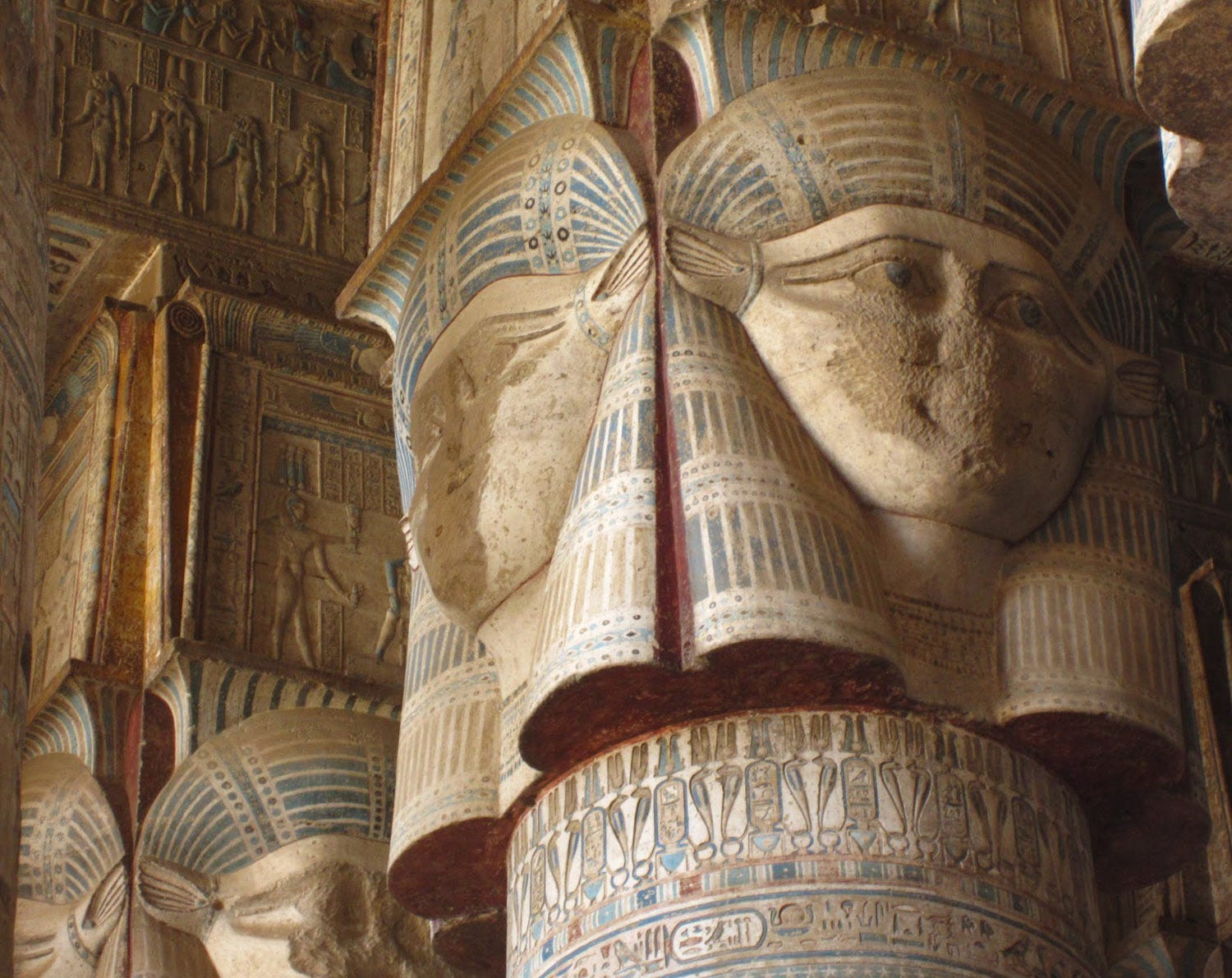
Timeline of the Imagery of Goddess Hathor in Ancient Egypt
Predynastic Origins (c. 4000–3100 BCE)
→ Sacred cow imagery and proto-Hathoric fertility symbolism
Early Dynastic Period (c. 3100–2686 BCE)
→ Royal mother goddess and protector of kingship
Old Kingdom (c. 2686–2181 BCE)
→ Pyramid Texts and emergence as a major state deity
First Intermediate Period (c. 2181–2055 BCE)
→ Expansion into regional and non-royal worship
Middle Kingdom (c. 2055–1650 BCE)
→ Funerary goddess, “Lady of the Sycamore,” protector of miners and travelers
Second Intermediate Period (c. 1650–1550 BCE)
→ Continued worship during political fragmentation and Levantine influence
New Kingdom (c. 1550–1069 BCE)
→ Peak worship, temple art, Book of the Dead imagery, Hathor welcoming the dead
Third Intermediate & Late Periods (c. 1069–332 BCE)
→ Syncretism with Isis and revival of traditional temple religion
Ptolemaic Period (c. 332–30 BCE)
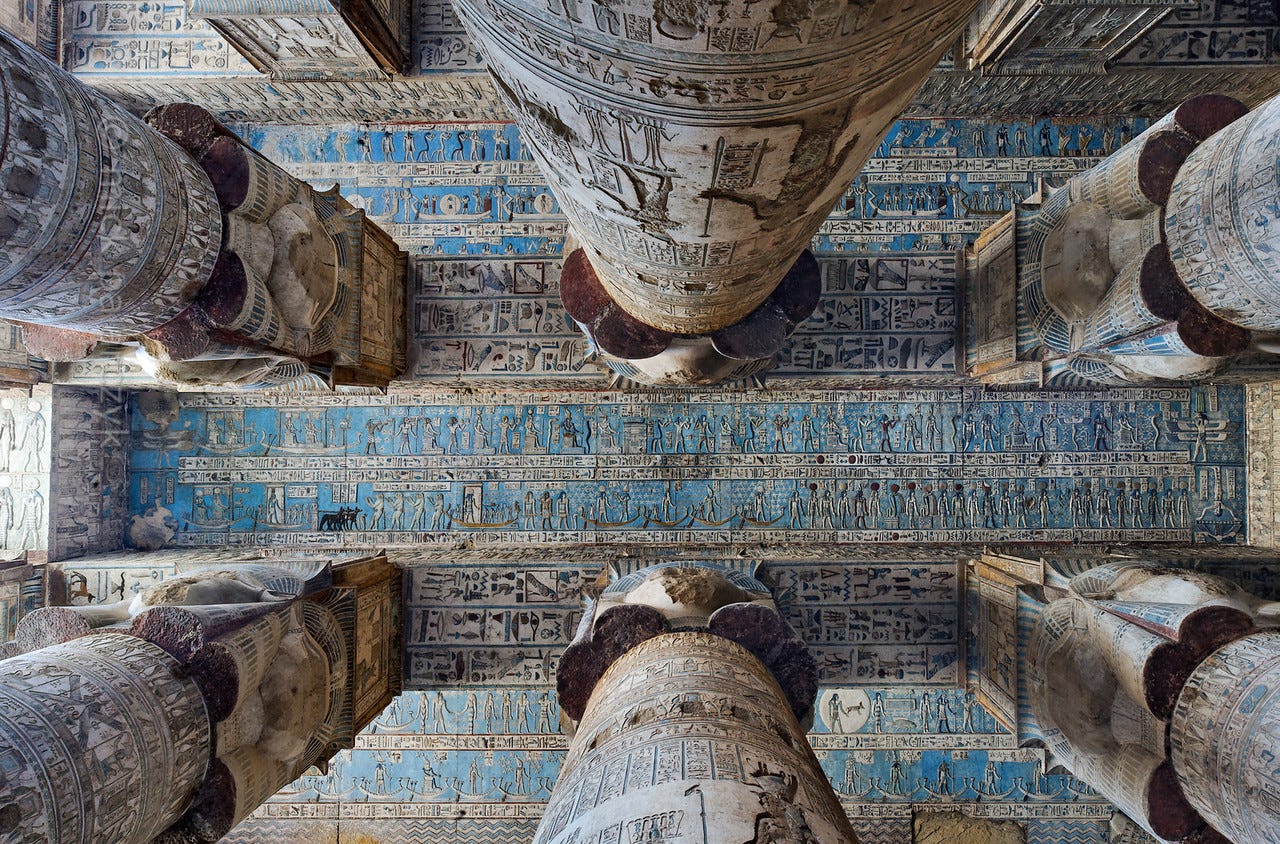
→ Dendera Temple theology, astronomical ceilings, full ritual canon
Roman Egypt (30 BCE–4th century CE)
→ Final flourishing and gradual decline of temple worship
Thank you, Roxana! I Love Hathor, and I Love that you shared this! I've tried researching her in the past, but I feel like you just offered more information than I've been able to find. Tell us more!
Astonishing to be reminded of how much civilization flourished before the Common Era. Thanks for this fascinating timeline. And hope you had a fabulous Mother's Day!